
Anti-Human Trafficking Program
Human trafficking is modern slavery and involves the use of force, fraud, or threats to obtain some type of labor or commercial sex act against a person’s will, often for little or no pay, or for something of value such as food, shelter, clothes, or drugs. It is crime whereby traffickers exploit and profit at the expense of adults or children. **All persons under age 18 who exchange sex for something of value are human-trafficking victims regardless of the presence of force, lies, or threats. A child cannot legally consent to commercial sex.
For All Seasons is proud to be a part of the Maryland Regional Navigator Program – serving human trafficking victims on the Mid-Shore of Maryland. This program connects our agency’s human trafficking team with experts across the state so that we can bring education, awareness, outreach, and resources to the community. Our therapists and our Rape Crisis Center advocates provide safe and confidential support to human trafficking survivors and their families across the Mid-Shore region.
For All Seasons is committed to providing training and information about human trafficking to help strengthen awareness and prevention in our region and beyond. Individuals, organizations, and businesses that are interested in a training or presentation should send a message to our Human Trafficking Team here:

Human Trafficking Awareness Month is January and For All Seasons is asking those who serve our community to join the Red Sand Project. The current threat of human trafficking is high, and it is crucial to keep shining a light on this critical issue.
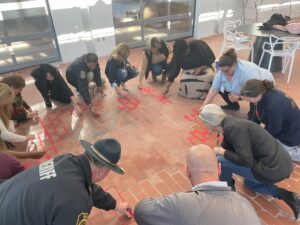 The Red Sand Project is a demonstration where participants pour red sand into sidewalk cracks and use the time to start a discussion about the causes and effects of human trafficking and exploitation. The red sand represents the victims of human trafficking who have slipped through the cracks, yet may still be hiding in plain sight. Photos and videos of the demonstration are taken and posted to social media.
If you are a local business, government, or non-profit organization, complete this Google Form to participate, and we will arrange to deliver red sand for your team.
Photos and videos can be sent to Dambrocio@forallseasonsinc.org anytime between now and the end of January so we can share them throughout the month.
Human trafficking is a hidden crime that thrives on secrecy and control. Victims are often afraid to seek help and may not realize they’re being exploited. As a mandated reporter, your vigilance can make the difference between a life of exploitation and a chance at freedom.
- How to identify potential trafficking victims and key behavioral, physical, and environmental indicators.
- The legal obligations for mandated reporters in Maryland, including your protections under the law.
- Step-by-step guidance on how to document and report suspected cases to ensure swift, appropriate action.
- How to provide trauma-informed support and collaborate with Regional Navigators, law enforcement, and other agencies.
To enroll multiple members of your team or for questions contact: CenterForLearning@ForAllSeasonsInc.org
Human trafficking affects communities across the country. Hotels, motels, and short-term rentals offer privacy, access, and constant guest turnover that traffickers exploit. Hospitality staff play a critical role in prevention. This introductory online course trains hospitality professionals to recognize and respond to human trafficking in lodging settings. This course features Sean Walker, a nationally recognized hospitality safety and security expert with over 25 years of experience. It focuses on real scenarios, clear indicators, and appropriate action steps for frontline and management staff.
- Front desk staff
- Housekeeping and maintenance teams
- Security staff
- Supervisors and managers
- Owners and operators
- A clear definition of human trafficking and how it differs from prostitution and smuggling
- Common behaviors and warning signs during check-in and throughout a guest’s stay
- Patterns to watch for, including foot traffic, room usage, and guest interactions
- How to respond using clear policies and team communication
- When and how to involve law enforcement safely and appropriately
- Ways to reduce anonymity while maintaining guest service standards
- Mental health considerations for staff who witness or report suspected trafficking
To enroll multiple members of your team or for questions contact: CenterForLearning@ForAllSeasonsInc.org

If you suspect a trafficking victim – reach out and share the information.
- FOR ALL SEASONS CRISIS HOTLINE English: 410.820.5600 | Espanol: 410.829.6143 English / Espanol Text: 410.829.6143 NATIONAL HUMAN TRAFFICKING HOTLINE 1.888.373.7888 Text HELP to 233733 (BeFree) CALL 911 in an emergency.
-
Attend a presentation or awareness event. If you would like to stay updated on any community events or presentations, keep in touch with For All Seasons. Send a message using the form above to our Human Trafficking Team
-
If you are a parent or a caregiver, know whom your child is talking to online. Talk to them about the risks of predators, remind them not to friend someone they do not know, never send photos and other personal information, and never meet up with people they do not know.
HELP IS AVAILABLE
For All Seasons provides help and support for any victim connecting with our team. For crisis support, contact For All Seasons’ 24-Hour Hotlines: English 410.820.5600, Spanish 410.829.6143, or text in English or Spanish 410.829.6143. The National Human Trafficking Hotline is 1-888-373-7888. Text HELP to 233733.
Learn More about Human Trafficking
RECOGNIZE THE RED FLAGS
There are many possible indicators of a human trafficking situation. Victims of human trafficking can be anyone—regardless of race, color, national origin, disability, religion, age, gender, sexual orientation, gender identity, socioeconomic status, education level, or citizenship status. But as is the case in many crimes of exploitation and abuse, human traffickers often prey upon members of marginalized communities and other vulnerable individuals, such as children in the child welfare or juvenile justice system or individuals without lawful immigration status.
https://www.justice.gov/humantrafficking/what-is-human-trafficking
As you read the possible signs and symptoms of a victim below, it is helpful to remember there is no single profile of a trafficked person.
-
Symptoms of physical abuse, malnourishment, exhaustion
-
Withdrawn, depressed, or distracted
-
Evidence of being controlled, restricted in movement, or difficulty communicating (no phone/email)
-
What appears to be branding or unusual tattoos
-
Chronic runaway of homeless youth
-
Inconsistent stories; hesitant to explain one’s work or living situation
-
Appearing fearful, submissive, nervous, paranoid
-
A juvenile in a new or unusual relationship with an adult
-
Unexplained access to expensive items or money
Human traffickers can be relatives, friends, individuals operating alone, or those affiliated with gangs or criminal organizations (national or transnational). Traffickers often take advantage of the instability caused by natural disasters, conflict, or a pandemic to exploit others. They tend to target marginalized and vulnerable individuals.
Human trafficking happens in all communities and does not discriminate based on age, class, gender, race, education, sexual orientation, or geographical location. It can occur in rural, suburban, and urban communities. Targeted victims may have an unstable home life, a history of sexual or physical abuse, nowhere to live, be a runaway youth, a substance user, have a lack of employment opportunities, or simply be a person who needs belonging and acceptance. Vulnerable individuals may have experienced sexual violence and trauma in the past, homelessness, involvement in the child welfare and juvenile justice systems, experienced substance abuse themselves or within their families, or be immigrants, LGBTQ youth, or developmentally or intellectually delayed individuals.
It’s hard to imagine what many of us think is an international crime can happen in all communities. The Eastern Shore is an attractive place for trafficking because of its geographic location in proximity to transportation routes by land, air, and sea that offer opportunities for human traffickers to go undetected.
In the United States, traffickers compel victims to engage in commercial sex and to work in both legal and illicit industries and sectors, including in hospitality, traveling sales crews, agriculture, janitorial services, construction, landscaping, restaurants, factories, care for persons with disabilities, salon services, massage parlors, retail services, fairs and carnivals, peddling and begging, drug smuggling and distribution, religious institutions, child care, and domestic work.
The U.S. State Department reports that human traffickers do not need to move a victim across a border for a human trafficking offense to take place. Trafficking in persons is a crime of exploitation and coercion and not movement. Traffickers can use schemes that take victims hundreds of miles away from their homes or exploit them in the same neighborhoods where they were born.
It’s hard to imagine that the global crime of human trafficking is happening across the state of Maryland and throughout the Eastern Shore. Major highways like I-95, Routes 40, 50, 301, and 13 all make transporting victims and meeting buyers easy. Maryland and the Mid-Atlantic region is an attractive destination for traffickers for several reasons including:
-
Three major international airports (Baltimore, Washington, D.C., and Philadelphia),
-
Inexpensive bus transportation
-
Train service along the East Coast
-
Large sporting events
-
A seaport
-
Truck stops
-
High rate of seasonal work
On the Mid-Shore, For All Seasons Rape Crisis Center has seen an uptick in trafficking victims through online sexual exploitation. Greater amounts of time online during the Covid epidemic and beyond have put youth at greater risk of being lured by online predators. These imposters often give the impression they are younger and romantically interested in the minor being targeted to earn their trust to gain illicit photographs or videos of the minor. Youth sometimes end up meeting up in-person with perpetrators they befriended online and this often leads to trafficking situations.
Parents and caregivers are highly encouraged to talk to their children about the risks of sharing personal information online and educate them on why they should not communicate with anyone they do not know, even if it appears to be another youth.
Parents must monitor their children’s use of all digital devices including laptops, tablets, desktop computers, gaming consoles, and smartphones. Traffickers tend to target marginalized and vulnerable individuals who may have experienced trauma or abuse, but any child can be at risk of being groomed by a predator.